Ducting and discharge
New duct routes, transitions, damaged-section replacement, supports and changes to roof or wall discharge arrangements.
Commercial kitchen extraction in Linbro Park for restaurants, canteens, hospitality, retail and business premises. We install, repair and maintain canopies, fans, motors and duct systems with the complete airflow path in mind.
Send your Gauteng location and service requirement. For the fastest response, WhatsApp photos of the fan, canopy, ducting or fault after submitting.
Chat on WhatsAppLinbro Park combines managed business estates with logistics and distribution activity. Extraction work therefore often has to satisfy both operational requirements and estate rules around access, roof work, contractor movement and visible external equipment.
Premises may include staff kitchens, corporate canteens, café-style food service and warehouse catering areas. These applications have different cooking loads, but all depend on a clear airflow path from canopy or pickup point through filters, fan and discharge.
A managed-park environment makes tidy routing and maintainable installation especially important. Supports, external duct sections, weather protection and fan mounting should be planned so the system performs without becoming an avoidable maintenance problem.
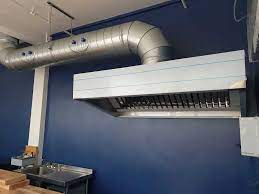
New duct routes, transitions, damaged-section replacement, supports and changes to roof or wall discharge arrangements.
Diagnosis of weak airflow, unusual noise, vibration, electrical trips, motor faults and complete fan failure.
Assessment of replacement-air conditions where negative pressure, drafts or poor canopy capture are affecting the kitchen.
Inspection and servicing of fans, filters, accessible ductwork, mounts and controls to reduce avoidable breakdowns.
Wall and island canopies for commercial cooking lines, including replacement, extension and integration with existing ductwork.
Axial and centrifugal fan installation, replacement and fault diagnosis for heat, smoke, odour and grease-laden air.
These services are often connected. A repair may reveal a duct restriction, while a new canopy may expose the need for a different fan duty or a better supply-air route. We scope the work around the cause and the intended kitchen use rather than treating each component in isolation.
Linbro Park combines managed business estates with logistics and distribution activity. Extraction work therefore often has to satisfy both operational requirements and estate rules around access, roof work, contractor movement and visible external equipment.
Premises may include staff kitchens, corporate canteens, café-style food service and warehouse catering areas. These applications have different cooking loads, but all depend on a clear airflow path from canopy or pickup point through filters, fan and discharge.
A managed-park environment makes tidy routing and maintainable installation especially important. Supports, external duct sections, weather protection and fan mounting should be planned so the system performs without becoming an avoidable maintenance problem.
Escaping heat and smoke can come from poor canopy coverage, filters loaded with grease, insufficient fan duty, duct resistance or strong cross-drafts around the cooking line. In Linbro Park, we do not assume the fan is automatically too small. We first look for restrictions and pressure conditions that could be reducing effective capture.
A running motor only confirms that something is turning. It does not confirm that the fan is producing the required airflow. Dirty impellers, slipping drives, reverse rotation, blocked filters, restrictive ductwork and inadequate make-up air can all create weak suction while the fan appears operational.
Electrical trips deserve investigation because the protective device may be responding to a genuine problem. Tight bearings, overloaded motors, contamination, damaged wiring, incorrect controls or mechanical obstruction can all raise current or temperature. Repeatedly resetting the system without identifying the cause can increase the risk of a more expensive failure.
Grease escaping around joints or collecting heavily in accessible sections can point to maintenance gaps, filter problems or unsuitable detailing. Cleaning may be part of the answer, but where the system is difficult to access we also consider whether the layout itself is making routine maintenance unrealistic.
Rattling, grinding, humming or structural vibration can indicate loose supports, worn bearings, fan imbalance, motor trouble or poor isolation. In a commercial environment, noise can also become a neighbour or staff issue before the system actually fails, so early diagnosis is worthwhile.
Odour problems are not always caused by poor capture at the canopy. Discharge too close to windows or air intakes can allow extracted air to re-enter the building. Wind effects and neighbouring structures can also influence where discharged air travels. The solution may therefore involve the external route rather than simply increasing fan speed.
A new operator in Linbro Park may inherit a canopy, duct and fan from a previous tenant. The visible stainless steel can look convincing even when the hidden route is unsuitable for the new cooking load.
We separate cosmetic condition from functional suitability. Reuse can save money, but only where the component size, route, condition and access remain appropriate.
During refurbishment, extraction should be coordinated early with ceilings, electrical work, roofing and kitchen equipment so late changes do not force an inefficient duct route.
A commercial extraction system in Linbro Park should be treated as one connected airflow path. The canopy captures heat, steam, smoke and grease; filters remove part of the load; ductwork carries the air; the fan creates movement; and the discharge releases it outside. If one section is undersized, blocked, badly routed or mechanically weak, the whole system can underperform even when the other components appear serviceable.
For managed business parks and logistics facilities, the first useful question is not simply what size fan to install. We need to understand the cooking equipment, operating hours, canopy position, route length, bends, vertical rises, available roof or wall discharge points and the air entering the premises to replace what is removed. Those details determine whether an existing system can be improved or whether a more substantial change is needed.
Local SEO searches for commercial kitchen extraction Linbro Park often come from businesses facing one of three situations: a new fit-out, an inherited system that never worked properly, or a previously reliable system that has deteriorated. We separate those cases because the correct response is different. New fit-outs need coordinated planning, chronic poor performance needs system diagnosis, and sudden failure often points to a mechanical, electrical or blockage-related fault.
A strong fan does not guarantee good capture. If replacement air cannot enter the building, the kitchen can become negatively pressurised and airflow at the canopy can weaken. In Linbro Park properties with sealed façades, air-conditioned interiors or multiple mechanical systems, make-up air deserves particular attention because the extraction fan is competing with the pressure conditions created by the building.
Duct resistance is another major factor. Every bend, transition, restriction, long horizontal section and contaminated internal surface adds resistance. A replacement fan selected only by the diameter of the old connection may produce disappointing results if the actual system pressure is ignored. We assess the practical route so fan choice is connected to the real installation rather than a label on the existing equipment.
Maintenance access should be considered before installation is finished. Fans mounted where technicians cannot safely reach belts, bearings, motors or electrical connections make future servicing unnecessarily difficult. The same is true for ductwork without sensible access to inspect grease accumulation or damaged sections. In Linbro Park, we favour layouts that can be maintained without dismantling half the kitchen or disturbing unrelated services.
Noise and vibration are useful warning signs. A system that becomes louder over time may be developing bearing wear, loose mounts, imbalance, motor trouble or airflow turbulence. Simply allowing the fan to continue until it stops can turn a smaller repair into a full breakdown. Businesses in Linbro Park that depend on daily food service should investigate new sounds early, especially when they are accompanied by weaker capture or overheating.
Grease management affects both performance and service life. Dirty filters increase resistance and can allow more contamination into the duct and fan. Where grease reaches an impeller, it can create imbalance and extra load on bearings and motors. Cleaning therefore supports airflow as well as hygiene, and the maintenance plan should reflect the actual cooking duty rather than a fixed interval copied from a different kitchen.
Electrical faults also need to be separated from airflow problems. A fan that does not start may have a control, isolator, capacitor, contactor, wiring or motor issue. A fan that starts and then trips may be overloaded, mechanically tight or electrically unhealthy. We diagnose the symptom before recommending replacement, because changing a good motor will not solve a blocked duct and replacing a fan will not repair a faulty control circuit.
When an old kitchen in Linbro Park is refurbished for a new tenant, reuse can be sensible if the equipment is suitable. A stainless canopy may remain useful after cleaning and modification, while a fan or duct route may no longer match the new cooking line. We assess each component separately so money is not wasted replacing usable equipment or, equally, preserving a weak link that will compromise the new installation.
Discharge position matters for neighbours and the building itself. Extracted air should not be directed toward openable windows, fresh-air intakes, pedestrian areas or neighbouring occupiers where it can create odour or nuisance problems. The best route depends on the property, and Linbro Park includes enough variation that discharge planning should be site-specific rather than assumed from a map.
For urgent faults, useful information speeds up the first response. Tell us whether the fan is completely off, humming, running slowly, noisy, vibrating, tripping or operating normally while suction remains weak. Photos of the canopy, filters, fan, motor plate, controls and visible ductwork can help narrow the likely fault before a visit, although a site inspection may still be needed to confirm the cause.
We separate mechanical faults from airflow restrictions, poor routing, undersized components, maintenance problems and building-pressure issues.
Roof access, work hours, landlord or estate requirements, electrical isolation and trading periods are considered before disruptive work begins.
Repairs or installation are carried out with attention to supports, joints, fan mounting, controls, weather exposure and future service access.
The system is run and obvious capture, noise, vibration and control behaviour are checked before handover where site conditions allow.
We establish the cooking equipment, operating hours, premises type, symptoms and whether the requirement is for a new installation, repair, refurbishment or planned maintenance.
Canopy, filters, fan, motor, controls, accessible ductwork, discharge position and replacement-air conditions are considered together rather than as isolated products.
This process is intended to reduce guesswork. A fan, canopy or duct section only adds value when it suits the duty and works with the rest of the system. Site information lets us distinguish an urgent component failure from a broader design or maintenance problem.
Where an urgent breakdown is affecting trade, the first goal may be restoring dependable extraction. Where the system is still operating but has always performed poorly, a broader performance assessment is usually more useful than a quick component swap.
Recording what has been installed or changed also helps later maintenance. Fan details, motor information, access locations and route changes make future troubleshooting more efficient and reduce repeated exploratory work.
In managed business parks, maintenance quality affects both system reliability and the appearance of the property. We recommend keeping fan bases, exposed ductwork and supports secure and tidy, while checking for vibration, corrosion, loose weatherproofing and grease contamination that can make an otherwise professional installation deteriorate quickly.
Tenant changes are a useful trigger for a proper extraction review. A new menu or cooking line can increase the duty without any visible change to the canopy. Before a new operator opens, checking fan condition, duct cleanliness and make-up air can reveal whether the inherited system is still suitable.
Estate access rules should also be recorded with the equipment details. Knowing who authorises roof access, where contractors sign in and which electrical isolation points are used makes future repair visits more efficient and less disruptive to the landlord or neighbouring tenants.
Managed estates typically value neat external presentation. Ducts, supports and roof-mounted equipment should therefore be installed with both serviceability and appearance in mind, avoiding improvised routes that are difficult to maintain later.
Corporate canteens may have quieter periods followed by high lunch demand. We consider the actual menu and peak cooking load rather than treating the kitchen as a simple office kitchenette.
Where tenant fit-outs change, landlord records and existing service drawings can be useful but should still be verified on site. Previous alterations are not always reflected accurately in documentation.
Because Linbro Park is well connected to nearby logistics nodes, businesses may compare repair versus relocation or refurbishment costs. A clear assessment of reusable components helps make that decision more rational.
We also cover Longmeadow, Modderfontein, Sandton. These pages focus on the different building types and operating conditions found in each local node while linking back to the wider Gauteng extraction network.
Yes. We provide commercial kitchen extraction installation and upgrade services in Linbro Park and surrounding Gauteng areas for restaurants, canteens, hotels, offices and other food-service premises.
Yes. We investigate weak extraction, abnormal noise, vibration, tripping, motor problems, control faults and complete fan failure while also checking for duct or airflow restrictions.
Coverage includes Linbro Park, Longmeadow, Modderfontein, Sandton and surrounding Gauteng areas, subject to site access and scheduling.
Sometimes. Reuse depends on condition, size, route, cleanliness, access and whether the existing components remain suitable for the current cooking duty.
Extraction removes air from the building. Adequate replacement air helps maintain controlled airflow and can reduce excessive negative pressure, drafts and poor canopy capture.
Send the Linbro Park location, premises type, work required, cooking equipment, symptoms and clear photos of the canopy, fan, visible ducting and controls where safe to photograph.
Tell us the premises type, cooking setup and whether you need a new installation, upgrade, repair or maintenance visit. If a breakdown is affecting service, explain whether the fan is completely down or still operating at reduced performance.